Entries from July 1, 2007 - August 1, 2007
Ward Farnsworth has penned a very good guest article at the Volokh conspiracy, on the subject of why politics is bad and trade is good.
Suppose the wreck of a ship is found on the ocean floor. Four teams race to lay hands on a treasure chest the ship is known to have on board; it contains artifacts worth ten million dollars. Each team spends about three million dollars trying to get there first. Eventually one of them succeeds, and the others are out of luck. Question one: do you see why this outcome is perverse?
The other day, when I posted about Amit Varma's best public convenience competition I thought my suggestion of the gothic spendour of the Isle of Bute's finest was a good one. But it turns out that the Victorians' finest has been put in the shade by the, erm, delights of another, via here:
There's been plenty of excitement in climate circles this week, so without further ado, here's what you may have missed.
The Lockwood & Frohlich paper and its claim to refute the solar theory of climate change continues to attract comment.
- Lubos Motl has comment from solar physicist Nir Shaviv, who reckons the paper is meaningless. Apparently Lockwood is using proxy measurements of solar activity (like sunspots) rather than measurements of the cosmic ray flux, and also doesn't consider the possibility of a damping which would introduce a delay between changes in cosmic ray flux and changes in temperature.
- Joe D'Aleo has a substantial paper pointing out flaws in Lockwood's thesis. In particular, he's been picking the brains of solar scientists Richard Willson and Nicola Scafetta.
Willson runs the NASA's ACRIM programme which collects the data on solar output. He thinks Lockwood should have used his ACRIM results rather than Frohlich's own PMOD series which represents ACRIM plus some heavily disputed "corrections".Scafetta points out that the results of the Lockwood paper would be quite different if they had used ACRIM instead of PMOD and takes Lockwood & Frohlich to task for not considering this. He also takes issue with their averaging technique which implies that temperature at any point in time is partly driven by the future output of the sun!
There's also more comment on the Armstong paper claims of the inadequacy of climate forecasts.
- Real Climate had a piece attacking the paper. While mostly knockabout stuff, they did make a substantial claim, namely that there is out of sample testing of climate models, although how you can test your model against the shambles of the paleoclimate reconstructions is beyond me.
- Jos de Laat of the Dutch Met Office reckons Armstrong's criticisms have hit the nail on the head
Surfacestations.org has now passed the 200 mark and should hit 20% of the network next week.
- The station at Tucson AZ was nominated as the worst in the network. It has also shown the fastest rising temperatures.
- A commenter at Climate Audit pointed out that not all AC units expel hot air.
- Surfacestations suffered a denial of service attack. Observers wondered if environmentalists were behind it.
- Police destroyed a suspicious weather station. Observers wondered whether this was a case of destroying the evidence.
- An US Weather Service insider has written to Anthony Watts complaining of NWS's resistance to modernisation of the network.
- The American Association of State Climatologists has written to Congress, complaining that the surface station network is close to collapse.
The Great Global Warming Swindle was shown on Australian TV to a great deal of hoo-ha. Martin Durkin said that the film survived the mauling it received.
Roger Pielke Snr continues to post on the failure of the IPCC to address the issue of land use and its effect on climate. This post has a huge list of papers that were ignored.
Next week should see a lot of interest in a new paper from two German scientists, Gerlich & Tscheuschner. They claim to have refuted the greenhouse theory of climate change once and for all.
And lastly, this letter to the FT:
From Mr Ake Nilson.
Sir, In your editorial "It's time to plan for the next deluge" (July 25) you say that "it is now scientifically incontrovertible that global warming is making heavy rain fall more frequently across the world's temperate latitudes". But less than a year ago, on August 10 2006, you reported: "This year's hot, dry summer will be repeated many times in the future and will become normal in the next 40 to 50 years if climate scientists are correct."
Please could you make up your mind as to the effect of global warming?
Ake Nilson
A couple of weeks ago a body calling itself the Optimum Population Trust called for families in the UK to limit themselves to a single child. The Times had this to say:
Britain’s birthrate, growing at its fastest for nearly 30 years – at 1.87 children per couple – is, says the author of its report, Professor John Guillebaud, an environmental liability. “Each new UK birth, through the inevitable resource consumption and pollution that UK affluence generates, is responsible for about 160 times as much climate-related environmental damage as a new birth in Ethiopia.”
Professor Guillebaud has three children. As does Sir Crispin Tickell, a patron of the Trust. The majority of the other patrons, and Prof Guillebaud's co-chair, Val Stevens, have two children each.
A commenter on the Bill of Rights thread reckons my current wording is open to abuse. At the moment it reads as follows:
The theory is that speech needs to be defined, and I can see the point. While the US courts have adopted a wide definition of speech (covering writing and other media) it is probably wise to make that clear. I think we might adopt something along the lines of "the free exchange of information, opinion and ideas". Information covers us on fact, opinion on things which are less settled, and ideas on the purely speculative.No law or regulation is permitted that restricts the right to freedom of speech or limits the freedom of the media.
The other area which is problematic is the extent to which the clause should cover commercial speech. The US Constitution is silent on this aspect, but the courts have found that while commercial speech is covered by the first amendment, the protections are less than those offered to non-commercial. Essentially speech regarding illegal products is out, as is deceptive speech.
Speech regarding illegal products seems a bit of a red-herring to me. You are hardly going to advertise your cocaine prices because it points the police straight to you.
Deception is different though. This is potentially a very risky area, since one man's "deceptive" is another's "true".
A thought occurs to me as to how we might get out of this, though. Since commercial speech forms part of a contract - the requirement to refrain from statements which are deceptive is contained in the common law. I wonder if we can distinguish between laws (written) and the common law (unwritten) in such a way as to prevent government from making laws that breach the principle of free speech and allowing common law to protect consumers.
So here's a revised suggestion:
Government shall make no law or regulation that restricts the free exchange of information, opinion and ideas, or limits the freedom of the media.
I've been planning a separate document on interpretation, and I think that this will be the place to make it clear that this does exactly what it says - ie it protects all speech including commercial speech.
So. What do you think?
So says Jesse Ausubel of Rockefeller University in New York, writing in the International Journal of Nuclear Governance, Economy and Ecology. The paper appears to be an analysis of the amount of land required per Watt of energy produced.
Biomass energy is also horribly inefficient and destructive of nature. To power a large proportion of the USA, vast areas would need to be shaved or harvested annually. To obtain the same electricity from biomass as from a single nuclear power plant would require 2500 square kilometers of prime Iowa land. "Increased use of biomass fuel in any form is criminal," remarks Ausubel. "Humans must spare land for nature. Every automobile would require a pasture of 1-2 hectares."
Obvious to everyone except greens.
Via The Volokh Conspiracy, this is a database of the records of the Old Bailey from 1674 to 1834. It's extremely nifty in that it has a graphing tool so you can easily analyse crimes, verdicts and punishments. I used it to generate a graph of crimes involving killing by decade (all verdicts).
![]()
Click for full size image The results are quite interesting. Apparently the Old Bailey saw between 10 and 15 cases involving killing each year during this period. Call it one per month. I wonder how many it is now?
To get a handle on the answer to this question, I've searched the Google News archive for pleas to charges of murder in 2006 and come up with 27 stories. Some, however, are duplicates and others are not actually Old Bailey cases at all. The edited list looks like this:
- the Monkton murder
- Mohammed Ali & his brother
- Tom ap Rhys Price
- Damilola Taylor
- Billie Jo Jenkins
- Trial of Daniel Gonzalez who killed four
- Samantha Renfrew
- Anne Mendel
- John Curran (reduced to manslaughter)
- Samaira Nazir
- Rochelle Holness
- Peter Woodhams
- Sally Anne Bowman
I think it's fair to say that by the time you've added in the manslaughter charges (and possibly the attempted murder charges too - the definition used is not clear) the current figure will be well in excess of what we saw in previous centuries.
This all deeply unscientific of course, but interesting nevertheless.
Via A Blogassault of Global Warming we learn that...
Keifer Sutherland, a.k.a Jack Bauer, blames all of us for global warming.
Star Kiefer Sutherland has already filmed a public service annoucement which begins: "Global warming is a crime for which we are all guilty!" While on the set of "24" they plan on being carbon neutral by the end of the season.
Rumours that Sutherland is also going to offset rising sea levels by drinking every bar in Los Angeles dry are apparently without foundation.
This is odd. Or do I mean appalling?
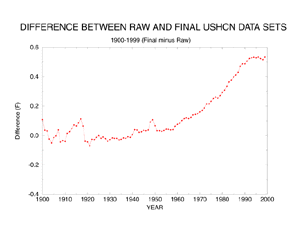
When you measure the surface temperature, the data that comes out of the station network is poor, and has to be "fixed". This is done by means of a series of adjustments which are added stepwise to the raw data to give the final answer.
I've show below a graph of the difference between the raw temperatures measured in the USHCN surface station network, and the final temperature delivered as an output.
What this appears to show is that most of the observed warming is coming from the adjustments, not the weather stations. (I'm assuming here that the trend in the final temperature is not more than 0.6oC)
The page from which the graph is ripped explains what the adjustments are:
- Time of observation. Different stations measure temperature at different times of day, but you want every station's midnight temperature. You therefore adjust anyone who is not reading at midnight, creating an estimate of what temperature it would have been if they had have done it at the correct time.
- Station moves
- Changes in equipment
- Missing data
- Urban heat island - as urbanisation takes place, an man-made warming trend is introduced, which needs to be eliminated to give the true temperature.
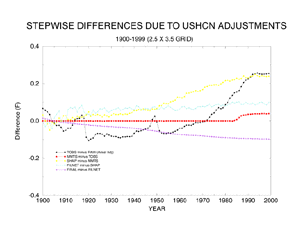
It also gives the impact of each. In the graph below, each line represents one of the adjustments.
From this, we can see that the warming trend is being produced by the time of observation adjustment (black) and by the station move adjustment (yellow).
I can think of no earthly reason why time of observation adjustments would produce this shape. The upward slope of the adjustment implies that there are many stations recording temperature at a time when it's colder than midnight. This means the wee small hours I guess. Why would this be? And why would the effect be increasing? I mean, over the last century more and more stations will be automatic, which presumably means that you could get temperature exactly when you want. Why then, does the raw data appear to be getting worse - ie the adjustment required to correct it is getting larger?
It all looks a bit fishy if you ask me.
Now that the CPS have decided that there is insufficient evidence to proceed with any prosecutions in the cash for honours affair, Guido is rounding up volunteers to back a private prosecution. While this is a great idea, there is a risk that the CPS take over the prosecution and then promptly drop it. The details of their powers in this respect are here; essentially they can drop the case if:
- There is so little evidence that there is no case to answer; or
- The prosecution falls far below the public interest test in the Code for Crown Prosecutors; or
- The prosecution is likely to damage the interests of justice.
It looks to my untrained eye as if the CPS would struggle to make a decent case for dropping it. They have refused to prosecute themselves because they don't think they can get a guilty verdict (let's leave aside the absurdly high standard they have set themselves). This is not the same as having so little evidence that there is no case to answer.
I can't conceive of any argument they could make that the prosecution was against the interests of the public or of justice, so there doesn't appear to be an "out" for the crooks here either.
The other thing to think about is the political fallout of the CPS taking over and then dropping a case against close confidants of the prime minister. It would look nothing if not very, very corrupt. Would Brown really risk it rebounding on him now that Blair is long gone?
So all in all, it looks like it's worth a punt. We live in hope.